
 |
|||||||
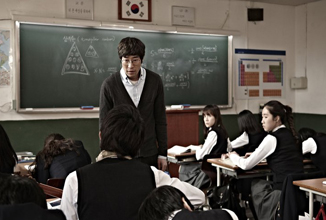
Synopsis: Seok-go (Ryoo Seung-beom) is a quiet and seemingly unassuming maths teacher living alone in a Seoul apartment block. Deeply enamoured with his neighbour, Hwa-seon (Lee Yo-won), he visits the cafe where she works each lunchtime without fail - always ordering the same takeaway food - but, try as he might, his shyness repeatedly prevents him from connecting with her on an emotional level; managing only an almost embarrassed 'hello' and 'thank you' he walks away frustrated and unfulfilled on each occasion.
Review: What would you be prepared to do for love? More than that, if someone told you they "did it for love" would you assume they meant love for someone or love from someone?
More than once during the course of the film, reference is made to a classical mathematical theorem that Seok-go has been obsessed with trying to prove since his school days. However, in helping Hwa-seon hide her crime his focus increasingly shifts from a sole preoccupation with the concept of a Perfect Number to a deep-rooted intellectual and emotional need to maintain her alibi and thereby create the perfect murder. This is added to yet further by the third piece in the character puzzle; that of Min-beom (Jo Jin-woong), the police detective in charge of the case who is also an old school friend of Seok-go: Ultimately, for all his intelligence Seok-go is set to find an answer he didn't even know he was looking for... the answer to the question "In a battle between heart and mind, which will win?"
The Diplomat -Seitz, Matt Zoller. “ The Diplomat Is a Gripping, Talky, Anti-Bombs-and-Explosions Thriller.” Vulture , 20 Apr. 2023, www.vulture.com/article/the-diplomat-netflix-review.html. This paper adheres to a standard academic format: an argumentative thesis in the introduction, body paragraphs that each advance a specific analytical claim supported by textual evidence, and a conclusion that synthesizes rather than summarizes. It is suitable for submission in a media studies, political science, or English literature course at the undergraduate level. Sewell, Rufus, performer. “The Beautiful Ache.” The Diplomat , season 1, episode 8, Netflix, 2023. The Diplomat In an era of televisual prestige drama dominated by anti-heroes and dystopian spectacle, Netflix’s The Diplomat (2023–present) offers a compelling counter-narrative: the bureaucratic thriller. Created by Debora Cahn, the series follows career diplomat Kate Wyler (Keri Russell) as she is unexpectedly appointed Ambassador to the United Kingdom during a volatile international crisis. However, beneath its surface of geopolitical intrigue, The Diplomat functions as a sophisticated dissection of late-stage American power, the gendered performance of diplomacy, and the psychological toll of perpetual crisis management. This paper argues that The Diplomat distinguishes itself from conventional political dramas by replacing ideological grandstanding with hard-nosed realism, while simultaneously critiquing the very structures of power its protagonist is expected to embody. Through its nuanced characterizations and dense plotting, the series posits that effective diplomacy is less an art of persuasion than an exercise in controlled self-erasure. Seitz, Matt Zoller Hal Wyler serves as her grotesque mirror. Where Kate is substance, Hal is pure performance. He manipulates, ingratiates, and violates protocol, yet his methods produce results. Their marriage becomes an allegory for the gendered division of political labor: she does the real work; he gets the credit. The Season One finale’s devastating reveal—that Hal orchestrated the very crisis Kate is trying to solve—turns this allegory into tragedy, suggesting that the system will always reward the operator over the honest broker. This paper adheres to a standard academic format: The narrative begins in medias res : a coordinated terrorist attack on a British aircraft carrier, the HMS Courageous , has left over forty sailors dead and threatens to ignite a broader Middle Eastern conflict. Kate Wyler, a seasoned crisis manager known for her work in dangerous hotspots (Afghanistan, Iraq, Lebanon), expects a posting to Kabul. Instead, she is sent to the “gilded cage” of the American Embassy in London. Her husband, Hal Wyler (Rufus Sewell), a charismatic former ambassador and political operator, is relegated to a secondary, ambiguous role. The primary tension is tripartite: Kate must manage the deteriorating relationship between the U.S. and the UK’s hawkish Prime Minister (Rory Kinnear); she must navigate the hidden agendas of her own State Department and the White House; and she must contend with the professional and personal sabotage enacted by her own spouse, whose ambition and habit of “fixing” things repeatedly undermine her authority. DVD The DVD edition reviewed here is the Korean (Region 3) Art Service Limited Edition First Press version. The film itself is provided as an anamorphic transfer with an aspect ratio of 2.35:1 and there are no image artifacts (and no ghosting) present.
'Perfect Number'
- Commentary by director Bang Eun-jin, Ryoo Seung-beom and Jo Jin-woong
|
|||||||
All images © Art Service Review © Paul Quinn |
|||||||