Portfolio Management Formulas Mathematical Trading Methods For The Futures Options And Stock Markets Author Ralph Vince Nov 1990

[ f = \frac(\textBW \times \textP) - (1-P)\textBW ]

Most trading systems focus on maximizing probability of profit or risk/reward . Vince focuses on maximizing the geometric growth rate of capital. 2. Core Concept: Optimal f (Optimal Fixed Fraction) This is the book’s most famous contribution. Optimal f is the fraction of account equity to risk on a single trade to maximize long-term geometric growth. The Formula (for a single trade scenario): You find the optimal f by maximizing the Geometric Mean (G) :

[ \textHPR_i = 1 + f \times \left( \frac-\textTrade_i\textWorst Loss \right) ]

This book is the sequel to his earlier Mathematics of Money Management and focuses specifically on and its application to portfolios of futures, options, and stocks. It is considered a foundational text for Quantitative Trading and Risk Management . 1. The Central Thesis: Money Management > Entry/Exit Signals Vince argues that how much you bet (position sizing) is more important than when you buy or sell. Two traders can have identical entry signals, but the one using optimal position sizing will outperform the other over time.


The Missing Header
One sharp idea each week to help you handle messy spreadsheets, weird exports, and undocumented CSVs — faster and smarter.

News  25th Apr, 2025: Tablecruncher goes Open Source!

Features

Open files bigger than 2GB and containing more than 15 million rows. Opening a 100MB CSV file with more than 500,000 lines takes less than 5 seconds on a dual-core Macbook Pro.
Use Javascript as a macro language to manipulate your CSV files. A simple API gives you access to all cells and you can change cell content as well as do abitrary calculations.
Export your table data to JSON. The exported JSON is an array-of-objects if there's a header row present in your CSV data. Otherwise you'll get an array-of-arrays.
🗃
Automatically detects most CSV file formats and file encodings for you. If you want, you can easily override the automatic detection and choose the appropriate CSV parameters.
📄
Open and save CSV files with one of these encodings: UTF-8, UTF-16LE, UTF-16BE, Latin-1 (ISO-8859-1) and Windows 1252 files. (These list will be extended in future updates.)
🔎
Use the powerful Find and Replace dialog to search for patterns in your table or in a selected area. Regular Expressions according to the ECMAScript 5 standard are supported.
🎨
Enjoy crunching your data with four beautifully designed color themes, including a dark theme that fits well with the Mac's dark mode.
𝌘
Flag rows manually or with the Find and Replace dialog and export flagged rows as a new CSV file.
𝌅
Modify your CSV data grid easily. You can sort lines alphabetically or numerically, move columns right or left or delete columns. Or set your first CSV row as a header row.

Portfolio Management Formulas Mathematical Trading Methods For The Futures Options And Stock Markets Author Ralph Vince Nov 1990 -

[ f = \frac(\textBW \times \textP) - (1-P)\textBW ]

Most trading systems focus on maximizing probability of profit or risk/reward . Vince focuses on maximizing the geometric growth rate of capital. 2. Core Concept: Optimal f (Optimal Fixed Fraction) This is the book’s most famous contribution. Optimal f is the fraction of account equity to risk on a single trade to maximize long-term geometric growth. The Formula (for a single trade scenario): You find the optimal f by maximizing the Geometric Mean (G) :

[ \textHPR_i = 1 + f \times \left( \frac-\textTrade_i\textWorst Loss \right) ]

This book is the sequel to his earlier Mathematics of Money Management and focuses specifically on and its application to portfolios of futures, options, and stocks. It is considered a foundational text for Quantitative Trading and Risk Management . 1. The Central Thesis: Money Management > Entry/Exit Signals Vince argues that how much you bet (position sizing) is more important than when you buy or sell. Two traders can have identical entry signals, but the one using optimal position sizing will outperform the other over time.
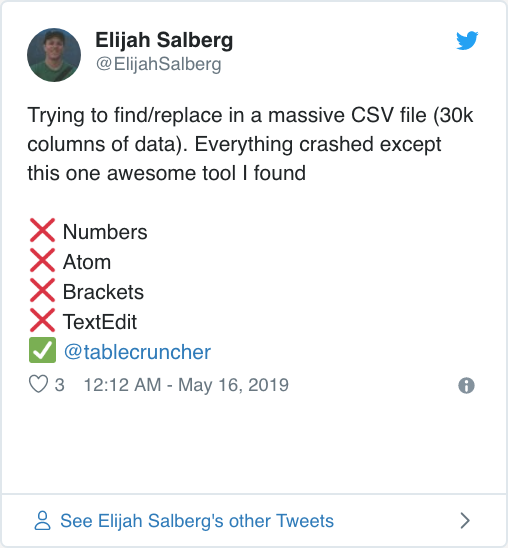
What others are saying

Not convinced yet? Head over to the GitHub repository to check out more details.

Blog

New beta for Tablecruncher 2

May 31, 2023

A new beta version of Tablecruncher 2 is available

First early beta for Tablecruncher 2

Dec 20, 2022

A very early first beta version for the completely rewritten version 2 of Tablecruncher is available

Roadmap for Version 2

Sep 12, 2022

The completely new version 2 for Tablecruncher is due this autumn.