









Always in sync, even across episodes
No more "wait, let me pause" moments. Our sync engine keeps everyone frame-perfect—even when you binge multiple episodes in one party.

Start playing any video on Netflix, Disney+, or 10+ supported platforms.
Click the Flickcall logo on top right once video starts or hit the Flickcall icon on chrome toolbar. Your watch party is ready in one click.
Copy the party link and send it to your friends. They join with one click—no sign-up required.
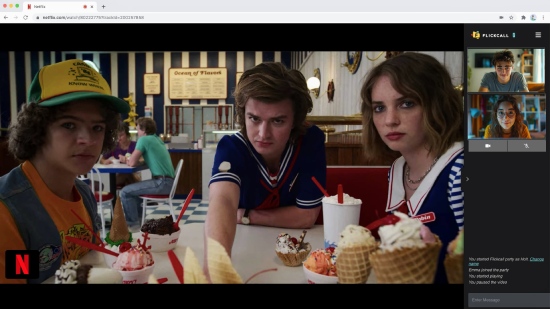
Create watch parties on Netflix, Disney+, JioHotstar, JioHotstar, HBO Max, MAX, Hulu, Prime Video, Youtube, Zee5, Sony Liv, JioHotstar with Flickcall.

No more "wait, let me pause" moments. Our sync engine keeps everyone frame-perfect—even when you binge multiple episodes in one party.

Catch your friends gasping at plot twists. Share laughter in real-time. Video chat makes every watch party feel like you're on the same couch.

Install the extension, play any video, click the Flickcall icon. That's it—share the link and you're watching together.
When you pause video, your mic unmutes. When you play, it mutes. Smart Mic knows when you need to talk. No fumbling with buttons, just natural conversation.

We use peer-to-peer technology to connect you directly with your friends. Your video calls and chats are never routed through our servers unless direct connection is blocked*.
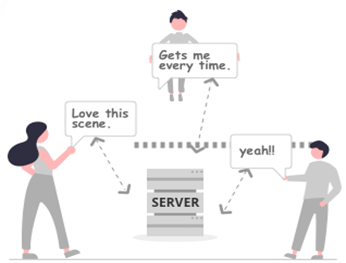
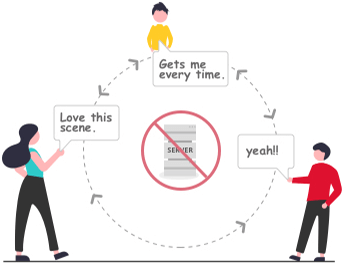
* In some cases, firewall setting doesn't allow direct connection, the calls and messages are encrypted and transmitted via routing servers.
#include <stdio.h> #include <stdlib.h> // Define the FIR filter coefficients float coefficients[] = {0.1, 0.2, 0.3, 0.2, 0.1}; // Define the input and output buffers float input_buffer[10]; float output_buffer[10]; // Define the FIR filter function void fir_filter(float *input, float *output, int length) { int i, j; for (i = 0; i < length; i++) { output[i] = 0; for (j = 0; j < 5; j++) { output[i] += input[i + j] * coefficients[j]; } } } int main() { // Initialize the input buffer for (int i = 0; i < 10; i++) { input_buffer[i] = i; } // Apply the FIR filter fir_filter(input_buffer, output_buffer, 10); // Print the output for (int i = 0; i < 10; i++) { printf("%f ", output_buffer[i]); } return 0; } This example illustrates a simple FIR filter implemented in C, which can be used for filtering digital signals.
C programming language is widely used for implementing DSP algorithms due to its efficiency, portability, and flexibility. C provides a low-level, hardware-independent programming environment that allows developers to optimize their code for specific hardware platforms.
Here is an example of a simple FIR filter implemented in C:
Digital media processing has become an essential aspect of modern technology, with applications in various fields such as audio and image processing, video compression, and telecommunications. Digital Signal Processing (DSP) algorithms play a crucial role in these applications, enabling the efficient and effective processing of digital signals. In this article, we will explore the use of C programming language for implementing DSP algorithms in digital media processing.
#include <stdio.h> #include <stdlib.h> // Define the FIR filter coefficients float coefficients[] = {0.1, 0.2, 0.3, 0.2, 0.1}; // Define the input and output buffers float input_buffer[10]; float output_buffer[10]; // Define the FIR filter function void fir_filter(float *input, float *output, int length) { int i, j; for (i = 0; i < length; i++) { output[i] = 0; for (j = 0; j < 5; j++) { output[i] += input[i + j] * coefficients[j]; } } } int main() { // Initialize the input buffer for (int i = 0; i < 10; i++) { input_buffer[i] = i; } // Apply the FIR filter fir_filter(input_buffer, output_buffer, 10); // Print the output for (int i = 0; i < 10; i++) { printf("%f ", output_buffer[i]); } return 0; } This example illustrates a simple FIR filter implemented in C, which can be used for filtering digital signals.
C programming language is widely used for implementing DSP algorithms due to its efficiency, portability, and flexibility. C provides a low-level, hardware-independent programming environment that allows developers to optimize their code for specific hardware platforms. digital media processing dsp algorithms using c pdf
Here is an example of a simple FIR filter implemented in C: #include <stdio
Digital media processing has become an essential aspect of modern technology, with applications in various fields such as audio and image processing, video compression, and telecommunications. Digital Signal Processing (DSP) algorithms play a crucial role in these applications, enabling the efficient and effective processing of digital signals. In this article, we will explore the use of C programming language for implementing DSP algorithms in digital media processing. Here is an example of a simple FIR